The Baseline Score
Your morning blood panel says "normal." Your afternoon energy, sleep, and waist say otherwise.
Four minutes. Nothing to look up.
1 of 9
What brought you here today?
Pick the option that is closest to where you stand right now.
What happens to your energy and focus between 2 PM and 5 PM?
A standard morning panel is drawn at your best hour. It is not measuring the part of the day you are asking about.
Your age and your weight today.
Roughly is fine on the weight. These two numbers set your daily protein target for holding and rebuilding lean muscle after 35.
Already, from that alone
0g
of protein a day, roughly 0g at each of three meals.
That is your exact target at 1.6 grams per kilogram of body weight (Morton et al., 2018), not a generic range. After 35, anabolic resistance rises and most men under-eat protein at breakfast and lunch, forcing their body to break down lean tissue when work stress is high.
How are you sleeping and recovering right now?
Seven hours in bed is not the same as seven hours of recovery, which is why we ask how you wake rather than how long you were down.
Over the last 12 months, what has happened to your stress load and midsection?
Sustained stress and midsection changes often travel together, which is why we score them as one input rather than two.
Two quick ones about this week.
Rough is fine. Nobody is checking, and a guess tells us more than a blank.
When you think about the next 90 days, what matters most to you?
Pick the one that actually sits with you.
Where should your score and plan go?
Your Cellular Depletion Score, your daily protein target, and your four-week baseline plan. Free, no card.
We use your numbers to calculate your baseline and compare against your 30-day re-test. Nothing else.
Your Cellular Depletion & Recovery Risk Score
What is driving your number
Every one of those drivers is a biological lever you can move inside 30 days. That is why we score your cellular inputs and recovery architecture rather than handing you a static lab sheet.
Before you go anywhere, one thing you can use tomorrow morning
Most men over 35 save their protein for dinner and run on caffeine until noon. That sets up the 3 PM wall.
When you wake up, morning cortisol is naturally peaking. If you skip protein at breakfast or eat mostly carbohydrates, blood glucose spikes and crashes by mid-afternoon while muscle protein synthesis stays switched off until evening.
Tomorrow morning (within 60 minutes of waking)
Three whole eggs plus one cup of plain Greek yogurt (or two scoops of whey isolate in water or milk). 45g
That banks 32% of your 0g daily target before your workday starts, triggers the leucine threshold for muscle retention, and flattens the afternoon glucose dip.
Your 4-week baseline plan is on its way to your inbox right now with these exact numbers built in.
The 24-Hour Cellular Restoration Loop
Why hitting your protein and lifting still hits a wall after 35.
Hitting 0g of protein and lifting three days a week gives your body the raw materials. But if your morning cellular ATP production is depleted, your afternoon cortisol stays pinned high from work stress, and your nighttime deep sleep is fragmented, your body never enters the anabolic recovery state required to use them.
The Baseline 90-Day Cellular & Physique System pairs your personalized nutrition and training blueprint with three clinical-grade, US-manufactured formulas timed to the three exact bottlenecks of the male 24-hour cycle:
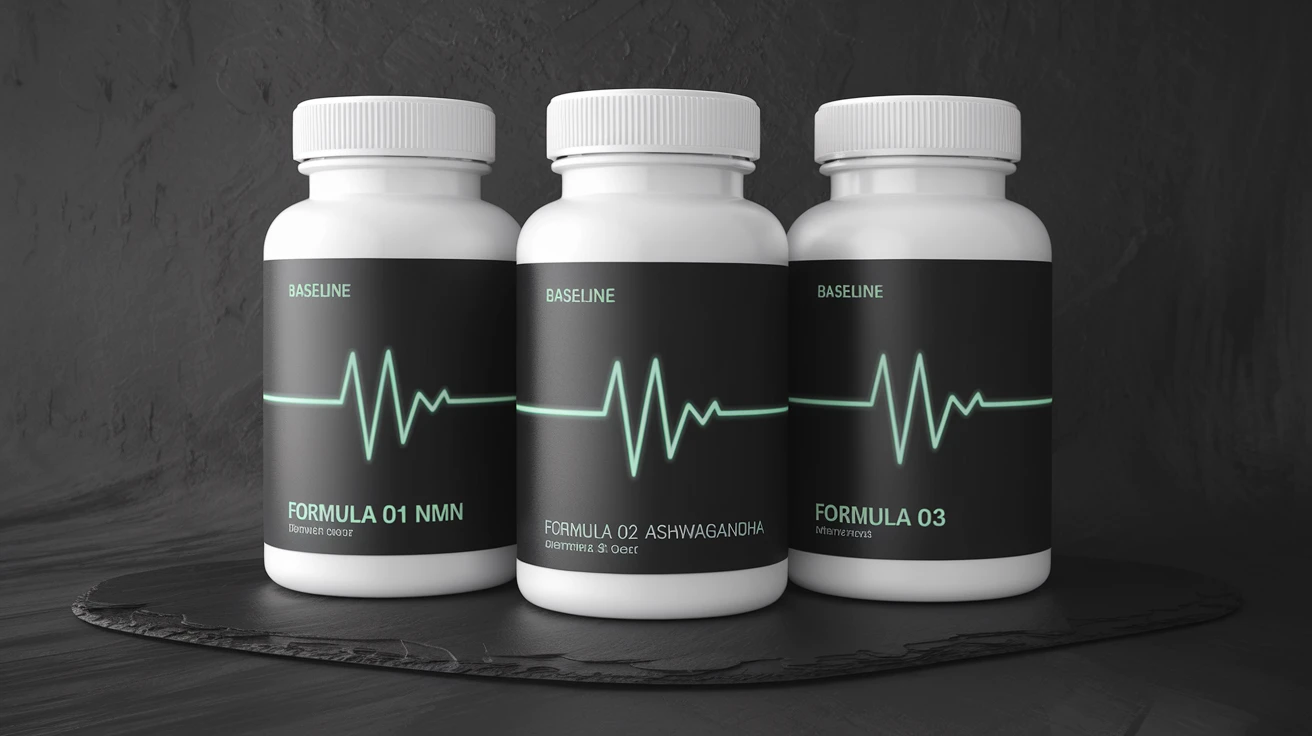
Complete 90-Day Supply: 9 Full-Size Bottles (3 of Each Formula) + Personalized 90-Day Protocol
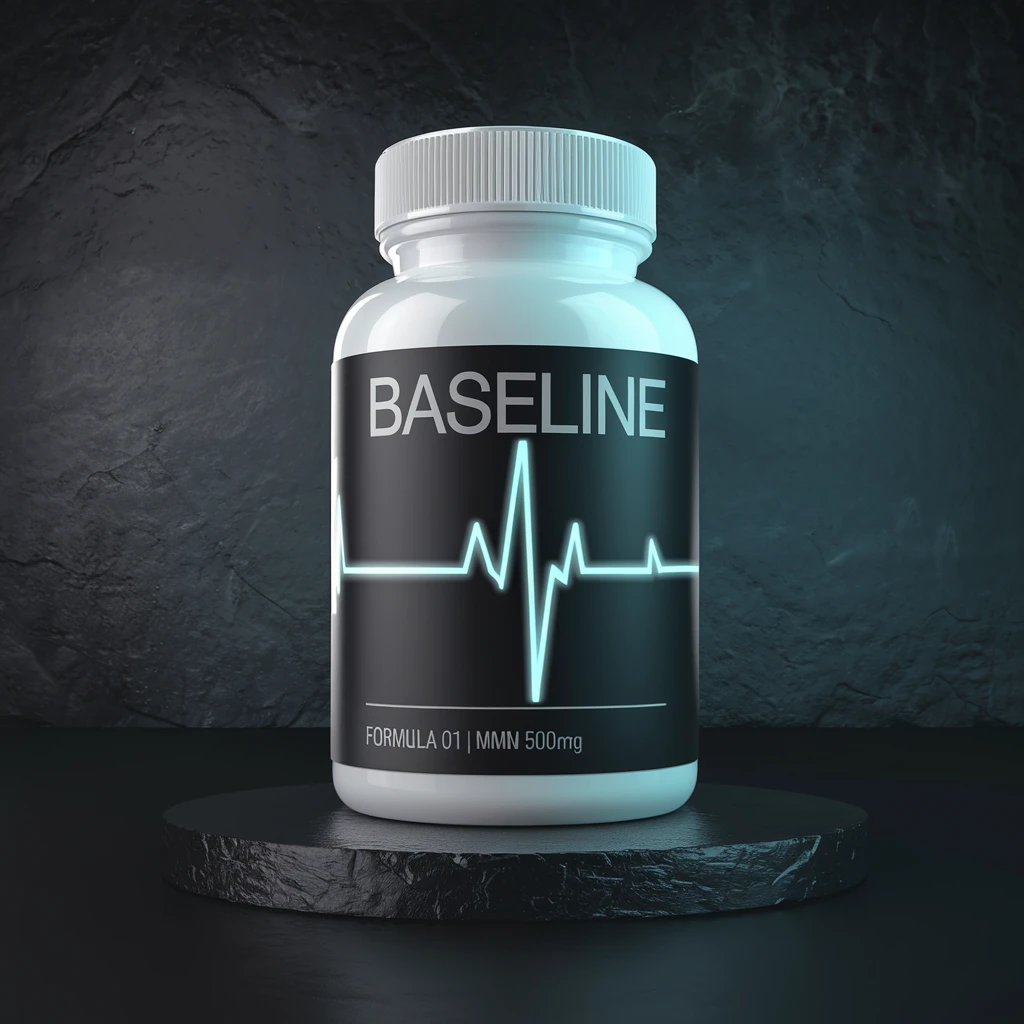
Formula 01: Cellular NAD+ (NMN 500mg) · 3 Bottles
500mg Beta-Nicotinamide Mononucleotide per capsule (1 capsule each morning, 90-day supply).
What it targets: Cellular NAD+ levels decline steadily after age 35, throttling mitochondrial ATP generation and causing the 2 PM cognitive and physical crash.
Clinical evidence & study limits: In a 60-day randomized, double-blind, placebo-controlled trial of 80 healthy middle-aged adults aged 40 to 65 (Yi et al., 2023, GeroScience), daily oral NMN (300mg to 600mg/day) produced statistically significant increases in blood NAD+ concentrations and 6-minute walking endurance compared to placebo. Safety of oral doses up to 500mg in men was confirmed by Irie et al. (2020, Endocrine Journal, n=10). Note: human trials measure 6 to 12 week functional endurance and NAD+ blood biomarkers rather than multi-year outcomes.

Formula 02: Cortisol & Drive (Ashwagandha Plus) · 3 Bottles
600mg Organic Ashwagandha Root + 600mg L-Arginine + 250mg Maca Root + 100mg Panax Ginseng + Vitamin D3 (25mcg) + Vitamin B6 & B12 (2 capsules midday, 90-day supply).
What it targets: Chronic daytime stress elevates serum cortisol, which competes directly with endogenous androgen signaling and drives visceral midsection fat storage.
Clinical evidence & study limits: In a 60-day randomized, double-blind, placebo-controlled trial of 64 chronically stressed adults (Chandrasekhar et al., 2012, Indian Journal of Psychological Medicine), 600mg/day of high-concentration Ashwagandha root extract reduced serum cortisol by 27.9% vs. 7.9% in placebo. In an 8-week RCT of 57 men aged 18 to 50 undergoing resistance training (Wankhede et al., 2015, JISSN), 600mg/day produced significantly greater gains in bench press and leg extension strength, muscle size, and exercise recovery vs. placebo. Results in Wankhede et al. required concurrent resistance training.
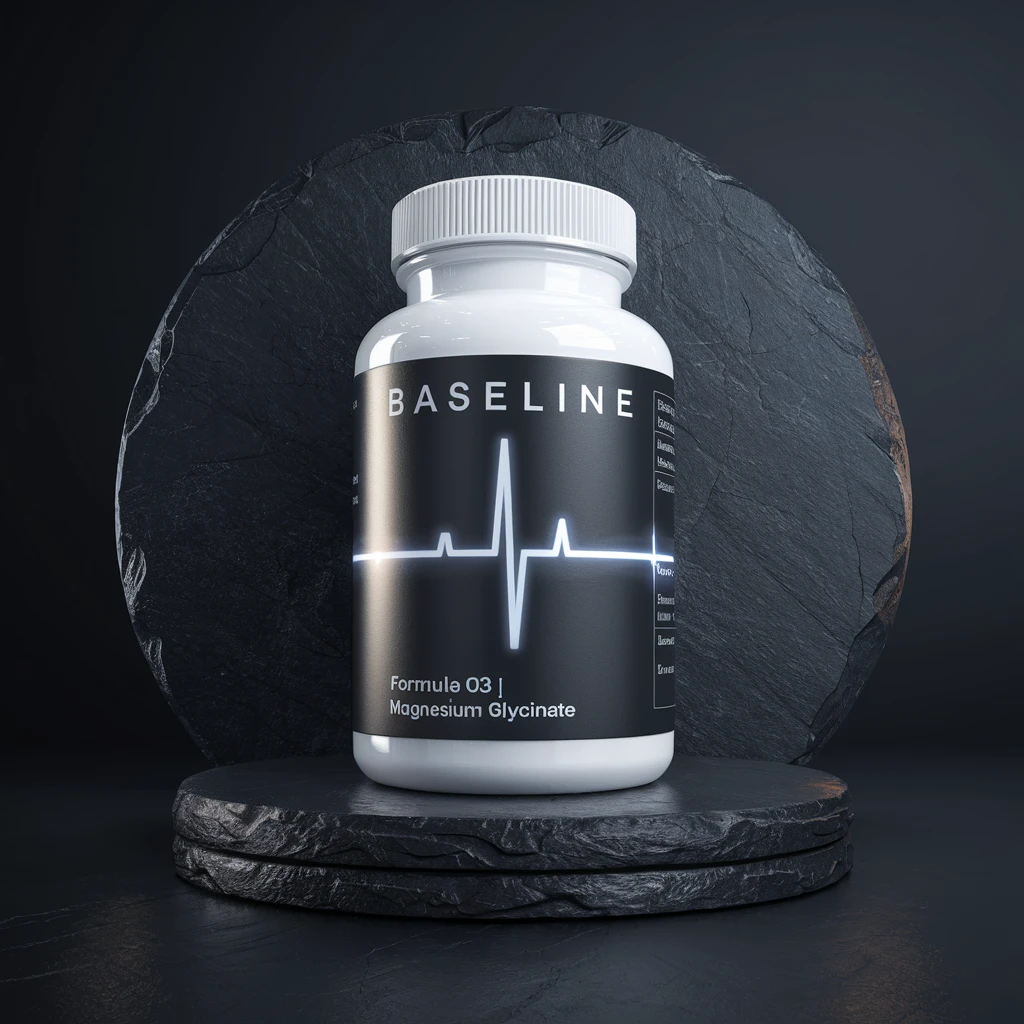
Formula 03: Deep Sleep & Recovery (Magnesium Glycinate 2,500mg) · 3 Bottles
2,500mg Chelated Magnesium Glycinate yielding 275mg elemental Magnesium (65% DV) per 3-capsule nightly serving (90-day supply).
What it targets: The 3 AM wired wakeup and unrefreshed sleep architecture that blunts nocturnal recovery and leaves muscles feeling tight and flat.
Clinical evidence & study limits: In an 8-week double-blind, placebo-controlled trial of 46 older adults with insomnia (Abbasi et al., 2012, Journal of Research in Medical Sciences), daily magnesium supplementation significantly increased total sleep time, sleep efficiency, and serum melatonin while reducing sleep onset latency and serum cortisol. Chelated glycinate avoids the laxative GI side effects of cheap magnesium oxide.
Everything Included in the 90-Day Transformation System:
- 9 Full-Size Bottles Delivered to Your Door: 3x Formula 01 (NMN 500mg), 3x Formula 02 (Ashwagandha Plus), and 3x Formula 03 (Magnesium Glycinate 2,500mg), manufactured in FDA-registered US facilities.
- Your Custom 90-Day Nutrition & Lifting Protocol: Built around your exact daily protein target and 3-day compound resistance blueprint (no 6-day gym grind required).
- 30, 60, and 90-Day Baseline Re-Tests: You re-score every 30 days so you can watch your risk score drop alongside your waist measurement and afternoon energy.
- 100% Natural Endogenous Support: Built specifically for men 35 to 55 who want their energy, focus, and physique back naturally, without ever shutting down their own hormone production on TRT.
Why I Built This
I am Victor Anirah. I competed as a natural physique athlete in the 2022 NPC Idaho Muscle Classic and spent years studying what actually preserves muscle, recovery, and cellular output as men cross 35.
Every week I hear from men whose doctors looked at a standard lab panel, told them "everything is normal for your age," and offered them either antidepressants or lifelong TRT injections. I built the Baseline 90-Day System for the man who refuses to accept operating at 50% and wants to restore his cellular engine, sleep, and physique 100% naturally.
Option 1 · Recommended First Step (Batch 01 Capped at 12 Systems)
Lock In Your Batch 01 Allocation for $10 Today
Batch 01 is small for a boring reason: we pay our US manufacturer before Stripe releases the first payment on a new account, so the first batch is only as big as we can fund. When it fills, the next one opens after it settles. Place a 100% refundable $10 deposit today to hold your place and get your protocol brief.
- 100% Refundable Anytime: Reply to your confirmation email at any point before shipment for an instant, no-questions-asked refund.
- Credited in Full: Your $10 deposit applies directly toward your $547 90-Day System when your Batch 01 shipment window opens.
- Priority Dispatch: Guaranteed allocation from our first US production run.
$10 refundable VIP reservation · credited toward your system
Reserve My Batch 01 Spot · $10 Deposit
One-time deposit via Stripe. Zero recurring charges.
Option 2 · Direct Full Order (Immediate Priority Queue)
Order the Complete 90-Day System Now
Ready to commit to the full 90 days right now? Order all 9 bottles (Formula 01 + Formula 02 + Formula 03) plus the full 90-Day Nutrition, Lifting & Re-Test Protocol in one step.
$182 / month ($547 total for 90 days · $6.07/day) · Free US Shipping
Or 4 interest-free payments of ~$136.75 with Klarna or Affirm at checkout.
Order Complete 90-Day System · $547
Backed by the Baseline 90-Day Unopened Bottle Return. Not a subscription. Want to read the full FAQ first? View the full Batch 01 breakdown →
Scoring Disclaimer: Your Cellular Depletion & Recovery Risk Score is an educational self-assessment indicator built from known lifestyle and physiological risk factors, not a medical diagnosis or laboratory test. Its primary value is measuring the directional change between your Day-1 baseline and your 30, 60, and 90-day re-tests.
Important Note on TRT: The Baseline 90-Day System is formulated for men seeking to support their natural cellular energy, stress recovery, and body composition without starting exogenous testosterone replacement therapy (TRT). It is not a medical treatment for clinically diagnosed hypogonadism or chemical HPTA suppression.
FDA Disclaimer: *These statements have not been evaluated by the Food and Drug Administration. These products are not intended to diagnose, treat, cure, or prevent any disease. Always consult a qualified healthcare provider before starting any new dietary supplement, nutrition, or exercise program.
What you get at the end
- 1 Your Cellular Depletion & Recovery Risk Score (0 to 100). Scored across the four biological bottlenecks that govern male performance after 35: mitochondrial ATP output, daytime cortisol load, deep slow-wave sleep, and anabolic protein signaling.
- 2 Your exact daily protein target. Worked out from your own body weight at the clinically supported 1.6 g/kg threshold for preserving and building lean mass (Morton et al., 2018), broken down per meal.
- 3 Your Day-1 Morning Protocol. The single highest-leverage breakfast and timing adjustment to flatten the 2 PM crash and switch on muscle protein synthesis before noon.
- 4 A 30-day re-test. One score now is a snapshot. Two is a trend line, and a trend line is the only way to prove whether what you are doing is actually working.