
If you have noticed your face looking thinner, more hollowed, or older since starting a GLP-1 medication, you are not imagining it. Ozempic face is a well-documented phenomenon that affects a meaningful percentage of people who lose significant weight on semaglutide or tirzepatide. Understanding why it happens and what you can do about it makes a substantial difference in the outcome.
What Is Ozempic Face?
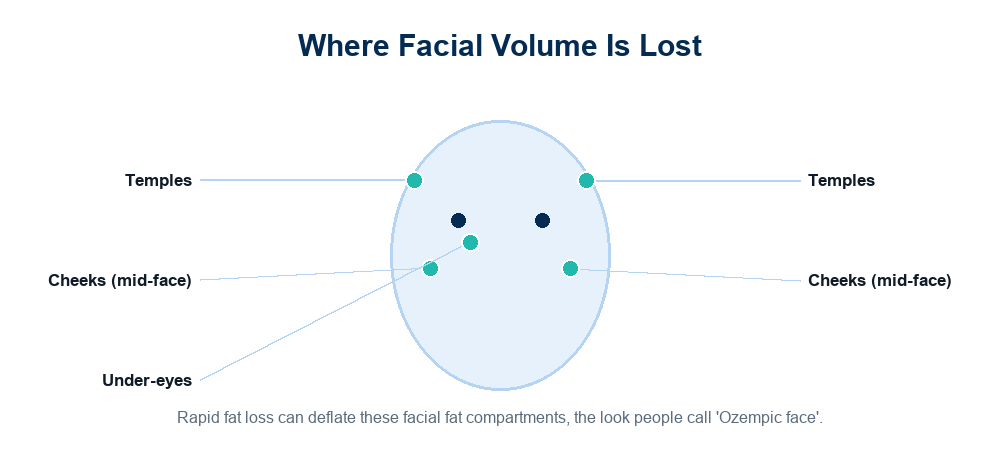
Ozempic face is the term used to describe facial changes that occur when people lose significant weight on GLP-1 medications like semaglutide (Ozempic, Wegovy) or tirzepatide (Mounjaro, Zepbound). The changes include hollowed cheeks, sunken temples, deepened under-eye hollows, and loose or sagging skin along the jawline and neck.
Despite the name, ozempic face is not a direct side effect of the medication. It is a consequence of rapid weight loss. When the body sheds fat quickly, the face often loses volume faster than the skin can contract and remodel, producing a deflated or prematurely aged appearance.
The term was first described clinically by dermatologist Dr. Paul Jarrod Frank in 2022. Since then, it has been examined in peer-reviewed research. A 2025 systematic review published in PubMed analyzed the phenomenon across plastic surgery literature and found it to be a consistent and well-documented aesthetic concern among GLP-1 users who experience significant weight loss.
It is also worth noting that this pattern is not unique to GLP-1 medications. The same facial changes occur after bariatric surgery and any other method that produces significant weight loss quickly. The term became culturally attached to Ozempic because GLP-1 medications are now the most common cause of medically guided rapid weight loss in the general population. The underlying mechanism is identical regardless of how the weight was lost.
Why Ozempic Face Happens
The face contains several distinct fat compartments, called facial fat pads, positioned in the cheeks, temples, and around the eyes. These compartments act as structural scaffolding for the overlying skin. When the body loses fat, these pads deflate, and the skin above them loses its underlying support.
The core problem is a timing mismatch. GLP-1 medications can produce weight loss of 15 to 22 percent of body weight within a year. That is rapid. The skin’s natural remodeling process, which includes collagen production and elastin remodeling, operates on a much slower timeline. The volume disappears before the skin can adapt.
This process is sometimes called deflation aging. It differs from the gradual facial changes that come with natural aging, though the visual result can look similar. The key distinction is speed. Natural aging unfolds over decades. Ozempic face can develop over months.
Older adults face a compounded risk. With age, facial fat reserves are naturally lower, collagen production slows, and skin loses elasticity. Someone in their 50s or 60s on a GLP-1 medication will generally experience more noticeable facial changes than someone in their 30s losing the same amount of weight.
What Ozempic Face Looks Like: Before and After
Before significant weight loss, even in people carrying excess body weight, the face tends to look structurally supported. Facial fat pads fill the cheeks, temples, and eye hollows, giving skin something to rest against. This fullness creates the rounded contours that register as youthful and well-rested, regardless of body weight.
After significant weight loss on a GLP-1 medication, the same face often looks deflated rather than simply thinner. The cheeks sink inward, the temples hollow, the under-eye area deepens, and skin at the jawline and neck begins to loosen. The change can add several years to perceived facial age even as the rest of the body is noticeably leaner and healthier.
The most commonly reported features include:
- Hollowed or sunken cheeks where the midface loses its fullness
- Deepened under-eye hollows, creating a tired or gaunt appearance
- Sunken temples that can make the skull appear more prominent
- Loss of jawline definition as lower facial fat pads deflate
- Loose or creped skin along the neck and jawline
- Deepened nasolabial folds (the lines running from nose to mouth corner)
- Marionette lines running downward from the corners of the mouth
- Thinning lips as perioral fat diminishes
Not everyone who loses weight on GLP-1s will develop noticeable ozempic face. The degree of change depends on how much weight is lost, the speed of loss, the person’s age, and their starting facial volume.
Who Is Most at Risk for Ozempic Face
Several factors increase the likelihood and severity of facial volume loss during GLP-1 therapy:
| Risk Factor | Why It Matters |
|---|---|
| Age over 45 | Lower baseline facial fat reserves and reduced skin elasticity |
| Rapid weight loss (more than 1.5 lbs per week) | Skin cannot remodel fast enough to keep pace with fat loss |
| High total weight loss (more than 15% of body weight) | Greater depletion of facial fat compartments |
| Low starting body fat percentage | Less facial volume reserve to work from |
| Sun damage or smoking history | Compromised collagen and elastin baseline |
A 2024 paper in Dermatological Reviews noted that facial soft tissues often fail to adapt proportionally to sudden volume reduction, particularly when the skin’s intrinsic remodeling capacity is outpaced by accelerated subcutaneous fat depletion.
How to Prevent Ozempic Face
Prevention is significantly more effective than treating volume loss after the fact. The strategies below address the root cause: the mismatch between fat loss speed and skin adaptation.
Slow the Rate of Weight Loss
The single most impactful strategy is controlling the pace of loss. Losing weight at a rate of 0.5 to 1 pound per week gives the skin considerably more time to adapt. This often means staying on lower doses of your GLP-1 medication for longer before titrating up, rather than escalating doses as quickly as the standard protocol allows.
Talk with your prescribing physician about a slower titration schedule if preserving facial volume is a priority. Many protocols accommodate this flexibility without sacrificing long-term outcomes.
Prioritize Protein Intake
Adequate protein supports both muscle preservation and collagen synthesis. Research consistently supports a target of at least 1.2 grams of protein per kilogram of body weight per day during significant weight loss. Higher intakes, around 1.6 to 2 grams per kilogram, are recommended for those incorporating resistance training. Our guide on what to eat on Ozempic covers specific protein sources and daily targets in detail.
Protein provides the amino acids needed for collagen production in the skin. A diet deficient in protein during rapid weight loss accelerates the loss of both muscle tissue and the structural proteins that support skin quality and resilience.
Resistance Training
Resistance training serves two relevant functions. First, it preserves lean muscle mass, which supports overall body structure including the face and neck. Second, it stimulates collagen production through mechanical loading and metabolic signaling in the skin.
Two to three resistance training sessions per week is sufficient to generate a meaningful protective effect. This does not require a gym. Bodyweight training with progressive resistance produces the relevant stimulus.
Hydration, Sunscreen, and Consistent Skincare
Well-hydrated skin maintains better elasticity. Aim for at least 64 ounces of water daily. This is especially important on GLP-1 medications, which can suppress thirst drive independently of hunger.
Daily sunscreen at SPF 30 or higher is an equally important and often overlooked step. UV exposure degrades existing collagen and elastin, compounding the effects of rapid volume loss. Protecting your skin from UV damage is the lowest-cost, most accessible collagen-preservation habit available, and it works regardless of age or skin type.
For additional support, products containing retinoids, vitamin C, and peptides all support collagen synthesis over time. Beginning a consistent skincare routine before or early in GLP-1 therapy gives the skin a better baseline from which to work.
Consider Proactive Collagen Stimulation
Some dermatologists recommend beginning collagen-stimulating treatments such as Sculptra or radiofrequency microneedling before visible volume loss occurs, rather than waiting until the changes are noticeable. These treatments work by triggering the body’s own collagen production over several months.
Starting early means collagen is being actively built while fat is being lost, partially offsetting the deflation effect. This approach requires consultation with a board-certified dermatologist or plastic surgeon and is not appropriate for everyone, but for those who prioritize facial appearance during GLP-1 weight loss, it is worth discussing proactively.
Week-by-Week Prevention Timeline
Knowing what to do is useful. Knowing when to do it is more useful. This timeline maps the key prevention actions to the stages of GLP-1 therapy, so you can build the right habits before facial changes appear rather than reacting after.
| Phase | Window | Priority Actions |
|---|---|---|
| Before starting | Week 0 | Schedule a dermatologist consultation. Establish baseline protein intake (1.2 g/kg/day). Begin daily SPF 30+ if not already doing so. Consider baseline collagen support (retinoid or vitamin C serum). |
| Dose ramp-up | Weeks 1-4 | Start resistance training 2x weekly. Prioritize protein at every meal. Monitor weekly weight loss rate; if exceeding 1.5 lbs/week, discuss slower titration with your prescriber. |
| Early therapeutic dose | Months 1-3 | Maintain protein target even as appetite decreases (this is when most people undereat protein). Continue resistance training. Re-assess injection site rotation. Watch for first signs of facial hollowing; address early if seen. |
| Active weight loss | Months 3-6 | If losing more than 10% of starting body weight, discuss proactive Sculptra or RF treatment with a dermatologist. Maintain hydration (GLP-1s reduce thirst signals). Weekly self-assessment of cheeks, temples, and under-eyes in consistent lighting. |
| Plateau / maintenance | Month 6+ | Weight stabilization reduces ongoing fat loss in the face. Focus shifts to skin quality maintenance: collagen-supporting skincare, continued SPF, resistance training. This is the right window to treat any existing volume loss, as further fat loss is minimal. |
The single most important window is months 1 to 3. This is when the rate of weight loss is typically fastest and when the mismatch between fat loss and skin adaptation is greatest. Taking action before visible changes appear makes a larger difference than responding after they develop.
What Slowing Titration Looks Like in Practice
Standard Ozempic titration escalates from 0.25 mg to 0.5 mg at week 4, then to 1.0 mg at week 8 or later. A slower titration for facial preservation might look like:
- 0.25 mg for 8 weeks instead of 4
- 0.5 mg for 8 weeks before moving to 1.0 mg
- Evaluating weight loss rate monthly rather than pushing for maximum dose
This approach delays reaching the highest dose by 4 to 8 weeks and typically reduces the rate of loss by 30 to 50% during the ramp-up period. It does not affect ultimate outcomes significantly, but it gives the skin meaningfully more time to adapt and also reduces the nausea and GI side effects that are most intense during rapid dose escalation.
Treatment Options for Existing Ozempic Face
If facial volume loss has already occurred, several well-studied treatment options are available. These are cosmetic interventions, not medical treatments. Ozempic face does not require treatment from a health standpoint, but for those bothered by the changes, effective options exist.
Dermal Fillers
Hyaluronic acid fillers (such as Juvederm and Restylane) restore volume to the cheeks, temples, tear troughs, and nasolabial folds. Results are immediate, last 12 to 18 months depending on the area and product used, and are fully reversible with a dissolving enzyme if needed.
Fillers address volume loss directly but do not rebuild underlying structure. They are generally a temporary measure and work best for moderate volume loss.
Sculptra
Sculptra is a poly-L-lactic acid collagen stimulator rather than a traditional filler. It works by triggering the body’s natural collagen production over a series of two to three treatment sessions, producing gradual improvement over three to six months that can last two years or more.
For ozempic face specifically, Sculptra is often preferred over hyaluronic acid fillers because it rebuilds structural support rather than simply adding volume. Results develop slowly but tend to look natural and last considerably longer.
Radiofrequency and Ultrasound Treatments
Devices such as Thermage, Ultherapy, and radiofrequency microneedling stimulate collagen and elastin in the deeper layers of the skin, improving laxity and reducing the crepiness that often accompanies facial volume loss.
A 2025 study in PubMed examined the use of endotissual bipolar radiofrequency specifically for ozempic face and reported meaningful improvements in skin tightening and facial contour. These treatments work best for mild to moderate laxity and are frequently combined with fillers or Sculptra for comprehensive results.
Fat Grafting
For significant volume loss, fat grafting transfers the patient’s own fat from the abdomen or thighs to the face. Results are long-lasting and tend to look natural because the volume comes from the patient’s own tissue.
Fat grafting is a surgical procedure requiring recovery time. Some of the transferred fat is absorbed in the weeks following treatment, so surgeons typically overfill slightly to account for this. It is generally reserved for more severe cases or patients who prefer a definitive surgical solution.
Is Ozempic Face Permanent?
The short answer: it depends on what happens with your weight.
If weight is regained, some facial volume will return. However, skin laxity that has already developed may not fully reverse on its own, particularly in adults over 45 where skin elasticity is already reduced. The skin has a degree of memory; once loosened significantly, it does not always rebound fully.
For those who maintain their weight loss, the facial changes are stable rather than progressive once weight stabilizes. They will not worsen on their own, but they will generally persist without treatment.
A Note on Perspective
The appearance of ozempic face has become a significant concern in public discussion of GLP-1 medications. It is worth keeping in proportion. The cardiovascular, metabolic, and longevity benefits of meaningful weight loss are substantial and well-documented. For many people, those benefits substantially outweigh cosmetic concerns.
That said, the concern is real and the distress it causes is legitimate. The strategies above, particularly gradual weight loss, adequate protein, daily sunscreen, and resistance training, give you meaningful tools to reduce the likelihood and severity of facial changes while still achieving the health benefits you are working toward.