
Most peptides marketed for fat loss and body composition are unapproved compounds with thin human evidence. Tesamorelin is a notable exception. It is an FDA-approved peptide medication with real clinical trial data behind it, which makes it one of the most legitimate names in the entire peptide conversation.
That said, the full story matters. Tesamorelin is approved for a specific medical use, not as a general fat-loss drug, and that distinction shapes everything about how it should be understood. This guide explains what tesamorelin is, what it actually does, and where the approved use ends and the gray market begins.
What Is Tesamorelin?
Tesamorelin is a synthetic peptide and a stabilized analog of growth hormone-releasing hormone, or GHRH. If you are new to this category, our guide on what peptides are covers how these amino acid chains act as signaling molecules.
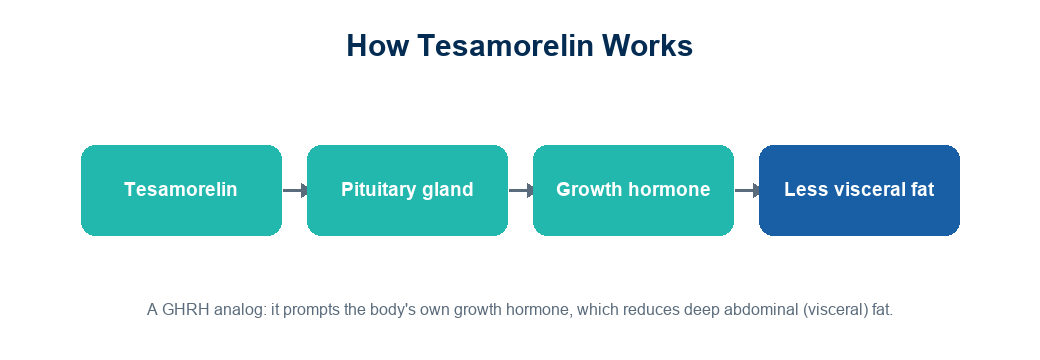
According to a scientific overview, tesamorelin works by binding GHRH receptors in the pituitary gland and stimulating the natural, pulsatile release of the body’s own growth hormone. A small structural modification protects it from being broken down too quickly, which is what makes it stable enough to work as a medication.
It is sold under the brand name Egrifta and is a prescription drug, not a supplement.
What Tesamorelin Is Approved For
This is the most important point, and it is where a lot of online discussion goes astray. Tesamorelin has a specific, narrow approval.
The FDA approved tesamorelin in 2010 for reducing excess visceral abdominal fat in adults with HIV-associated lipodystrophy, a condition that causes abnormal fat buildup. As Theratechnologies announced, a newer formulation with weekly reconstitution has since been approved to make treatment easier.
It is, as medical coverage notes, the only FDA-approved therapy for that specific condition. General weight loss and bodybuilding are not approved uses.
How Well Does Tesamorelin Work?
The clinical evidence is genuinely solid, which again sets tesamorelin apart from most peptides.
In a pooled analysis of 806 participants across two phase 3 trials, tesamorelin reduced visceral adipose tissue by approximately 15.4% compared with placebo at 26 weeks, along with improvements in triglycerides. These are real, peer-reviewed results in human patients, not animal data or anecdote.
The key nuance is what kind of fat it targets. Tesamorelin reduces visceral fat, the deep fat around the abdominal organs, rather than producing broad, overall weight loss. It is a targeted tool, not a general obesity drug.
Tesamorelin vs GLP-1 Medications
Because tesamorelin gets discussed alongside fat loss, it helps to compare it directly to the GLP-1 drugs people know.
| Feature | Tesamorelin (Egrifta) | GLP-1 drugs (semaglutide, tirzepatide) |
|---|---|---|
| Type | GHRH analog peptide | GLP-1 based peptide |
| Main effect | Reduces visceral abdominal fat | Reduces appetite, large overall weight loss |
| Approved for | HIV-associated lipodystrophy | Type 2 diabetes, obesity |
| Mechanism | Raises the body’s own growth hormone | Mimics the GLP-1 gut hormone |
As detailed in research on GLP-1 medications for weight management, the GLP-1 class drives broad weight loss through appetite. Tesamorelin does something narrower. For most people focused on overall weight, the GLP-1 class is the relevant tool, which we cover in our peptides for weight loss and GLP-1 vs peptides guides.
The Off-Label and Gray-Market Reality
Here is where caution returns. Because tesamorelin raises growth hormone and reduces visceral fat, it has attracted interest from people seeking fat loss or anti-aging benefits outside its approved use.
Using tesamorelin this way is off-label, meaning it is not an approved or studied use, and any benefits or risks in that context are far less established. More importantly, tesamorelin sold through the gray market or research-chemical channels is not the regulated, approved Egrifta product. It carries the same problems as other unregulated peptides: uncertain purity, inaccurate dosing, and no medical oversight.
The approval that makes tesamorelin credible applies only to the real, prescribed medication used as intended.
Is Tesamorelin Safe?
As an approved drug used under medical supervision, tesamorelin has a documented safety profile from its trials. Reported side effects include injection-site reactions, joint pain, swelling in the limbs, and effects related to raising growth hormone, such as changes in blood sugar.
Like other growth hormone-related peptides, including the CJC-1295 and ipamorelin stack, it should be approached carefully and only with professional guidance. It is also prohibited in competitive sport under anti-doping rules, so tested athletes should avoid it.
The Bottom Line
Tesamorelin stands out as a genuinely FDA-approved peptide with real human evidence, approved specifically to reduce visceral fat in HIV-associated lipodystrophy. That makes it one of the most legitimate compounds in the peptide world when used as intended.
But it is not a general weight loss drug, and off-label or gray-market use strips away the very approval that makes it trustworthy. If your goal is fat or weight loss, start with the approved options in our peptides for weight loss guide and discuss any growth-hormone peptide with a qualified healthcare provider first.