If you have heard the word peptides everywhere lately, from weight loss clinics to skincare ads to gym conversations, you are not imagining it. Interest has exploded. But the word gets used so loosely that it often creates more confusion than clarity.
So what are peptides, really? In the simplest terms, peptides are short chains of amino acids, the same building blocks that make up proteins. Your body produces them naturally and uses them as messengers. This guide explains what they are, what they do, and why the same word can describe both a life-saving medication and an unregulated vial sold online.
What Are Peptides, Exactly?
Amino acids are small molecules that living things use to build proteins. According to Cleveland Clinic, your body needs 20 different amino acids to function, and they help break down food, repair tissue, and make hormones and brain chemicals.
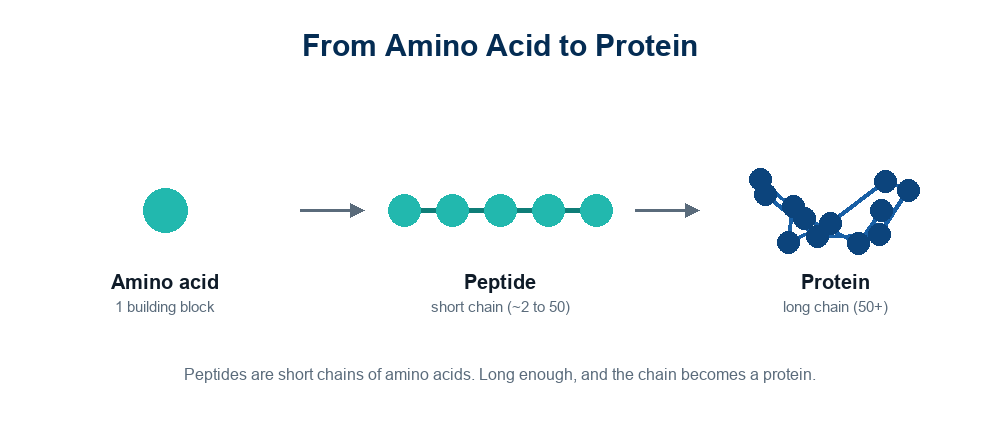
When amino acids link together in a short chain, that chain is a peptide. As NIH reference material describes, peptides are essentially short proteins, generally made of about 2 to 50 amino acids. Once a chain grows past roughly 50, scientists usually call it a protein instead.
The simplest way to picture it: amino acids are single links, peptides are short chains, and proteins are long chains. Same raw material, different lengths.
Peptides vs Proteins vs Amino Acids
These three terms get mixed up constantly. Here is how they relate.
| Term | What it is | Rough size | Example |
|---|---|---|---|
| Amino acid | A single building block | 1 unit | Leucine, glutamine |
| Peptide | A short chain of amino acids | About 2 to 50 | Insulin, GLP-1 |
| Protein | A long chain of amino acids | More than about 50 | Collagen, antibodies |
The key takeaway is that all peptides are made of amino acids, and proteins are just longer versions of the same thing. The boundaries are based on length, not on being fundamentally different substances.
What Peptides Do in the Body
Peptides are not just structural. Many of them are active signaling molecules that tell your body what to do.
WebMD notes that because peptides are smaller than proteins, they can pass into tissues and interact with receptors more easily, which is part of why they are so useful in medicine and skincare. They act like messengers, carrying instructions between cells.
Some of the most important hormones in the body are peptides. Insulin, which moves sugar out of your blood and into your cells, is a 51-amino-acid peptide. GLP-1, the appetite and blood-sugar hormone that drives the entire class of GLP-1 medications, is a peptide too. So when people ask what are peptides, the honest answer is that some of them are among the most essential molecules you have.
The Main Types of Peptides People Search For
When people use the word peptides today, they usually mean one of a few different categories. Sorting them out removes most of the confusion.
Metabolic and hormonal peptides. These include the GLP-1 medications like semaglutide and tirzepatide. They are FDA-approved, prescription drugs studied in large trials. We compare these directly to the wider peptide world in our guide on GLP-1 vs peptides.
Recovery and repair peptides. This group includes BPC-157 and TB-500, marketed for tissue healing and recovery. These are not approved for human use, and most of their evidence comes from animal studies.
Growth hormone peptides. Compounds like CJC-1295 and ipamorelin are used to stimulate the body’s own growth hormone release. They are also unapproved for general use.
Cosmetic peptides. These appear in skincare products and are applied to the skin to support collagen and skin appearance. They are a different use case from injected peptides entirely.
Prescription Peptides vs Wellness Peptides
This is the single most important distinction, and most articles skip it. The word peptide covers two very different worlds, and the gap between them is regulation.
Prescription peptide medications, like the semaglutide in Ozempic and Wegovy, are FDA approved. They are manufactured under strict quality control, dispensed at standardized doses, and backed by large clinical trials. You know exactly what is in the vial.
Wellness or research peptides are a different story. Many are sold labeled for research purposes only, are not approved for human use, and come with no guarantee of purity or dose accuracy. The OPSS warning on BPC-157 is a clear example, describing it as an unapproved drug found in wellness products. Same word, completely different level of oversight.
Are Peptides Safe?
The safety of a peptide depends entirely on which one you are talking about. There is no single answer.
Approved peptide drugs have well-documented side effects precisely because they have been studied so thoroughly. That documentation is a sign of rigor, not danger. You and your doctor can weigh known risks against known benefits.
Many wellness peptides look cleaner only because no one has run the trials that would reveal their risks. Long-term human safety data for compounds like BPC-157 and TB-500 is very limited or nonexistent. Unregulated products also carry the added risks of contamination and inconsistent dosing. Less information is not the same as more safety.
Are Peptides Legal?
Legality also depends on the specific compound. Approved peptide medications are legal with a prescription and dispensed through licensed pharmacies.
Many wellness peptides sit in a legal gray area. They are often sold for research use only, a label that signals they are not intended or verified for human use. BPC-157 was placed in FDA Category 2 in 2025, restricting compounding pharmacies from making it. We cover that situation in detail in our guide on whether BPC-157 is legal. Several recovery peptides, including TB-500, are also banned in competitive sport under the World Anti-Doping Agency prohibited list.
How to Tell if a Peptide Is Third-Party Tested
If you are researching wellness peptides, you will see sellers advertise third-party testing. Here is how to read that claim honestly.
Look for a Certificate of Analysis, or COA, from an independent laboratory rather than the seller itself. A real COA shows the compound’s identity and measured purity. Be especially cautious with anything labeled for research use only, because that label usually means the product was never intended or verified for human consumption in the first place.
The important caveat is that third-party testing only confirms what is in the vial. It does not make an unapproved compound safe, effective, or legal to use. Purity and approval are two separate questions.
The Bottom Line
So, what are peptides? They are short chains of amino acids that your body uses as messengers, and some of them, like insulin and GLP-1, are essential to life. The confusion comes from one word being stretched to cover both rigorously tested medications and unregulated compounds sold online.
If you are exploring peptides for metabolic health, the most studied and proven options are the prescription GLP-1 medications. Our guide on GLP-1 vs peptides breaks down how they compare to the wider peptide market, and our muscle loss guide covers the recovery concerns that lead many people to peptides in the first place. Whatever you are considering, judge it by its category and its evidence, not its marketing, and involve a qualified healthcare provider before you start.